Category: devops-101

  • DevOps 101: Continuous Improvement and Learning

    Courtesy: Wikimedia Commons

    No development team is perfect. Even the highest-performing teams can improve on what they’re doing, or else they probably need tweaks from time to time as knowledge, attitudes, situations, and responsibilities evolve.

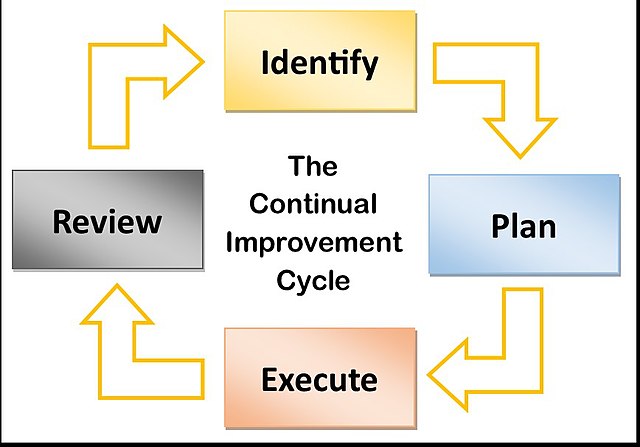
    Continuous improvement is a fundamental principle of DevOps, promoting a culture of ongoing learning, feedback, and enhancement. The ideal of continuous improvement involves iteratively identifying areas for improvement, implementing changes, and measuring the impact to drive further refinements.

    Look, I get it: this seems like super-basic stuff. And it is! These things feel obvious, they’re pretty easy to get right, and you can easily forget about Continuous Improvement when a team is functioning well. But I’ve seen more than one team fail to implement a simple end-of-sprint retrospective, and the results are not good.


    Read more!

  • DevOps 101: Cross-Functional Teams

    Crayons (courtesy of Wikimedia Commons)
    Courtesy Wikimedia Commons

    Cross-functional teams play a vital role in a DevOps culture as they bring together individuals with diverse skills and expertise from different areas of software development and operations.

    By embracing cross-functional teams, organizations can foster collaboration, improve communication, streamline processes, and create an environment conducive to innovation and continuous improvement. In a DevOps culture, where speed, agility, and quality are paramount, cross-functional teams play a crucial role in breaking down barriers, improving collaboration, and delivering high-value software efficiently.

    Read more!

  • DevOps 101: Keeping it Agile and Lean

    DevOps didn’t come from nowhere, and it doesn’t operate in a vacuum. Any time you’re trying to apply DevOps principles, there are already going to be existing ways of doing things either in the workplace or, at the very least, in the minds of the team as they come together. You might build a team of thirty professionals, and they would have thirty different opinions on the “right” way to do things.

    Relatedly, it’s hard to define DevOps, because it’s one of those terms that’s used in slightly different ways by different people. There’s a fair amount of debate about what is and isn’t DevOps.

    There’s a whole discussion about whether or not it should be “DevOps” or “DevSecOps” and whether or not the two terms refer to the same thing. In a future post, I’ll explain why I prefer the term DevOps, even though I think everyone would agree that the “Sec” (Security) portion of the culture is extremely important.

    Read more!

  • DevOps 101: Culture and Mindset

    Old-style rotary phone. Courtesy of Wikimedia Commons.
    Courtesy Wikimedia Commons

    I’m sure everyone wants to start by diving into pipelines or traces or something. I certainly wanted that as a learner: get me straight to the technical stuff! But DevOps is more than just a set of tools or technologies; it’s a mindset, a way of thinking, a commitment to bridging the gap between development and operations (and security — more on that later) to enable faster and more reliable software delivery.DevOps culture encourages:

    • Breaking down silos and fostering a sense of shared ownership and accountability.
    • Open communication, trust, and mutual respect among team members.
    • Blameless culture, where failures are seen as learning opportunities rather than occasions for blame.

    Read more!

  • DevOps 101: Hello There!

    Edit 2025-02-14: I originally planned to do these as a series of blog posts, but I’ve consolidated them into static pages in order to make them easier to put together and easier to find.


    Whenever I’m studying for something, I have a habit of writing out my notes in full as if someone else were going to read them. It’s not because I think anyone ever will read them; it’s because I only have two modes of note-taking:

    • I can be a polished author, writing in full sentences and carefully formatting things so that it’s well-presented, and somewhat aesthetic.
    • Or I can write in the shortest of short-hands, like I’m an ancient scribe and my ink is worth more than I am: I’ll use half-words and abbreviations that I’m likely to forget in a few days. I’m not really capable of doing anything in between: my notes are either Hemingway or they’re “Obs: mtrc, trc, lg!”

    Read the rest!